The Imperial Palace East Garden — Kokyo Higashi Gyoen — is not a park. It is the former inner compound of Edo Castle, opened to the public in 1968 after the current imperial palace building was completed on a separate section of the grounds. Understanding the zone structure of what you're walking through transforms the visit from a pleasant stroll into something considerably more interesting.
This guide walks through every major zone and structure in the order you encounter them on the standard route from the Ōte-mon Gate. For a full historical account of how these zones developed, see our Imperial Palace history page.
The Entry Gates — Three Ways In
The East Garden has three public entry points, each with a different character and historical function. Understanding which gate you enter through changes your first impression of the garden significantly.
Ōte-mon Gate — The Formal Front
The primary public entrance and the gate through which official visitors to Edo Castle would have arrived. The masugata (square enclosure) system is visible here: a pair of gates with a walled courtyard between them, requiring anyone entering to make a sharp right-angle turn — exposing them to archers positioned above on both walls. The gate's exposed timber and plasterwork structure is one of the most complete surviving examples of Edo castle gate architecture in Tokyo. Most guided Imperial Palace tours begin by entering here.
Hirakawa-mon Gate — The Service Gate
Historically used for the movement of everyday goods, servants, and less formal traffic. The gate retains its wooden doors and masugata courtyard. Less visited than Ōte-mon, making it a quieter entry option on busy days. The name "Hirakawa" refers to the small waterway that once ran past this section of the moat.
Kitahanebashi-mon Gate — The Drawbridge Gate
Named for the hanebashi (drawbridge) that once spanned the moat here. The position of this gate — overlooking the northern moat — made it a key defensive checkpoint. It is closest to Kitanomaru Park and Kudanshita Station, making it the natural entry point if you are approaching from Chidorigafuchi after the moat walk.
Zone 1 — The Three Guardhouses
Immediately inside the Ōte-mon Gate, you encounter the first of the garden's three surviving Edo-period guardhouses. Understanding all three as a sequence rather than individual buildings is essential — they are one of the clearest surviving illustrations of the Tokugawa social hierarchy encoded in physical architecture.
The three guardhouses are arranged in order of increasing samurai rank. The further into the castle compound you moved, the higher the status of the guards you encountered. This meant that any visitor approaching the Shogun had to pass through three progressively more senior security checkpoints — and the architecture of each guardhouse communicated clearly which tier of authority was operating there.
Doshin-bansho (Constable Guardhouse, 1628)
The smallest and lowest-ranked of the three. Staffed by doshin — low-ranking samurai responsible for checking credentials and controlling pedestrian traffic at the outer gate. The simple, single-storey construction reflects the rank of those inside. "Doshin" literally means "same heart" — a reference to their collective role as constables of the castle precincts.
Hyakunin-bansho (Hundred-Man Guardhouse)
The largest surviving Edo guardhouse in Japan. "Hyakunin" means "hundred men" — the garrison who staffed this post around the clock in rotating shifts of 20 people. The four clans who rotated through this duty were all from domains that had supported Tokugawa Ieyasu at the Battle of Sekigahara in 1600 — this was an honour posting as much as a security function. The long, low building with its curved tile roofline is architecturally the most impressive of the three.
Ōban-sho (Senior Guardhouse)
Staffed by ōban — the highest-ranking retainers from the most prestigious samurai families. Its position at the inner gate of the Honmaru compound made it the final checkpoint before the Shogun's living quarters. The contrast between the three guardhouses in terms of size, position, and the complexity of their fittings communicates the hierarchy precisely.
This is the single section of the East Garden where a guided tour makes the biggest difference. The guardhouses look similar to each other without context. With a guide explaining the rank system, the tour of the Shogun clan affiliations, and the political significance of the Sekigahara connection, you leave understanding something that no information panel conveys. The Shogun Historical Walking Tour spends around 25 minutes at the guardhouses alone.
Zone 2 — The Tenshukaku Donjon Ruins
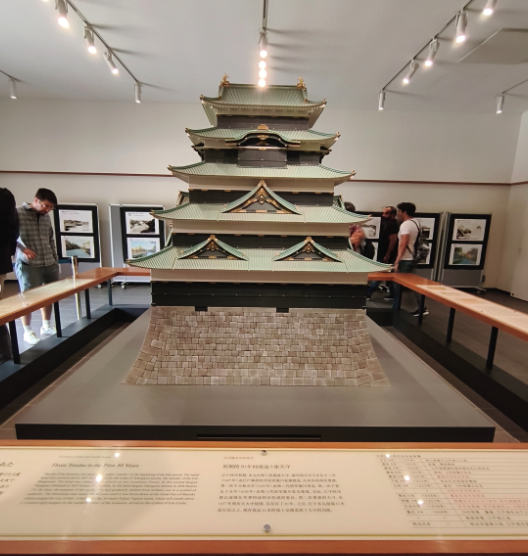
The emotional centrepiece of the East Garden. The Tenshukaku was the five-tiered main keep of Edo Castle, completed in 1638 under Shogun Tokugawa Iemitsu. At the time of its completion, it was the tallest structure in Japan — taller than any surviving castle keep today. In 1657, the Meireki Fire swept through Edo and the Tenshukaku burned. The Shogunate chose not to rebuild it.
What remains is the stone base — a massive platform of granite blocks assembled by daimyo labour from across Japan. You can climb to the top. The view from the platform looks out over the East Garden and the surrounding city — and the emptiness above you is the point. The absence of the keep is the exhibit.
The decision not to rebuild the Tenshukaku was not simply a matter of resources. The Tokugawa shogunate was, by 1657, the uncontested power in Japan — they had no rivals who needed to be impressed or intimidated by a towering keep. The historian Conrad Totman has argued that the keep had served its psychological purpose and its continued absence sent a different but equally powerful message: the Shogunate was so secure it no longer needed visible symbols of military dominance.
Zone 3 — The Ninomaru Garden
The Ninomaru ("second compound") Garden occupies the former secondary fortified enclosure between the Honmaru (main compound) and the outer castle defences. Today it is a traditional Japanese strolling garden — one of the most serene spaces in central Tokyo, with a central pond, stone lanterns, a tea arbour (Suwano-chaya), and carefully maintained seasonal plantings.
The garden was redesigned in 1965 by a landscape architect working in the tradition of the Ogawa school, using traditional Edo-period conventions as a reference. The planting programme is specifically designed for seasonal interest:
- Late March to early April: cherry blossoms on the garden's ornamental trees
- Early June: iris display in the bog garden section (historically significant — irises were cultivated in this compound during the Edo period)
- October to November: Japanese maple colour — the most photographed seasonal display in the garden
If you visit in autumn, the Ninomaru Garden maple colour peaks from mid-October to mid-November. The garden is at its least crowded in the late afternoon on weekdays — the light is also better for photography of the pond reflections. The irises in early June are far less-known than the cherry blossoms but are genuinely beautiful and draw a fraction of the spring crowds.
Zone 4 — The Tokagakudo Concert Hall
Built in 1966 for the 60th birthday of Empress Kojun (grandmother of the current Emperor Naruhito), the Tokagakudo is one of the most architecturally distinctive modern structures in the East Garden — and one of the most overlooked by visitors who don't know what they're looking at.
Its roof references the petal form of the tōka (wisteria flower), the personal emblem of Empress Kojun. More striking are the outer walls, which are covered entirely in mosaic made from fragments of pottery and ceramic pieces — the work of artist Kokei Kobayashi. The effect is of ancient tiles dissolved and reassembled into a new surface, simultaneously modern and deeply rooted in Japanese ceramic tradition.
The hall is used for imperial concerts and is not regularly accessible to the public. You can view the exterior from the garden path — it is worth pausing for the wall texture alone.
Zone 5 — The Fujimi-yagura Keep
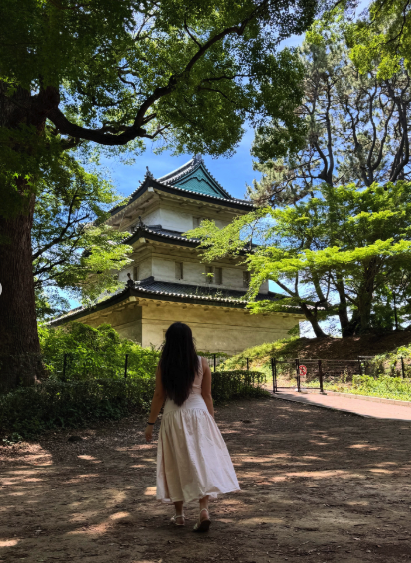
One of three original Edo Castle keeps still standing, the Fujimi-yagura ("Mt. Fuji-view Keep") was built in 1659 — two years after the Meireki Fire destroyed the Tenshukaku — and has survived intact ever since. The name comes from the view it once commanded toward Mount Fuji to the southwest. On clear winter days, that view is still possible from the garden area near the tower.
Seeing the Fujimi-yagura after the Tenshukaku stone base makes the loss of the main keep viscerally clear. The three-tiered structure — white plastered walls, curved tile rooflines, the heavy stone base — is exactly what the Tenshukaku would have looked like, scaled up to five tiers. The surviving keep is the template; the ruins are the missing original.
The Fujimi-yagura is included in the Imperial Palace East Garden & Edo Castle Walking Tour (2.5 hours, from $35) but is not on the standard 2-hour Shogun tour route. If this structure is a priority for you, book the longer tour or ask your guide about the route before the tour begins.
The Outer Grounds — Accessible Year-Round
Outside the East Garden but still part of the palace precincts, the outer grounds and moat walks are accessible year-round without any entry restrictions.
Nijubashi Bridge and the Seimon Ishibashi
The most photographed view of the Imperial Palace — the iron bridge (properly called the Seimon Iron Bridge, completed 1888) with the Fushimi-yagura Keep in the background. Accessible from the public plaza south of the East Garden at any time. The Fushimi-yagura Keep visible here is one of three surviving Edo Castle towers, reportedly relocated from Fushimi Castle in Kyoto after the Battle of Sekigahara in 1600.
Chidorigafuchi Moat Walk
The northwest moat walk — one of Tokyo's premier cherry blossom spots in late March and early April. The 300-metre path runs alongside the moat beneath a canopy of weeping cherry trees. Rowing boats are available from the boathouse in season (typically ¥500–800 per person). Worth visiting year-round for the moat reflections and the view of the palace stone walls.
Recommended Route — Self-Guided (1.5–2 hours)
Enter via Ōte-mon Gate. Walk clockwise: Doshin-bansho → Hyakunin-bansho → Ōban-sho → Tenshukaku stone base (climb) → Ninomaru Garden → Tokagakudo Concert Hall → exit via Ōte-mon or Hirakawa-mon. Add 30 minutes to continue to Fujimi-yagura. After exiting, walk south to Nijubashi viewpoint (15 minutes) or northwest to Chidorigafuchi (15 minutes).
For a guided walk with full historical context, the Shogun Historical Walking Tour ($22, max 15 guests, 4.9★) covers this route in 2 hours. The Edo Castle Garden Walking Tour ($35, fully wheelchair accessible) adds the Fujimi-yagura and runs 2.5 hours.