Most visitors to the Imperial Palace East Garden know it is large, historic, and free. Few know why the most important structure on the site is missing, or that the surrounding city was underwater when the castle was founded. These 15 facts change the way you see the place — before you arrive, or on a guided Imperial Palace tour where a good guide will tell you most of them anyway.
Tokyo Bay once came almost to the castle walls
When Ōta Dōkan built the first fort on this hill in 1457, the shoreline of Tokyo Bay extended almost to the base of the bluff he was building on. The districts you pass through to reach the palace today — Ginza, Marunouchi, Shimbashi — were tidal marshes and shallow sea. Centuries of land reclamation have pushed the coast kilometres to the east. The palace sits on what was, in 1457, a narrow hilltop peninsula jutting into the bay.
The founder was a warrior poet who never intended to be a general
Ōta Dōkan (1432–1486), who built Edo Castle in 1457, was better known during his lifetime as a poet than as a military commander. He composed waka poetry, corresponded with court poets in Kyoto, and contributed significantly to the transmission of classical Japanese poetic forms to the warrior class. He was assassinated on the orders of his own lord, Ōgigayatsu Sadamasa, apparently because he had become too famous and too competent.
Tokugawa Ieyasu was sent to Edo as a political punishment
In 1590, Toyotomi Hideyoshi — having unified most of Japan — ordered Tokugawa Ieyasu to leave his power base in the fertile provinces of central Honshu and relocate to the remote, undeveloped Kanto plain. It was designed to weaken him by removing him from his support base. Ieyasu used the move to transform Edo into the largest city in the world. By 1600, his victory at the Battle of Sekigahara had made him the most powerful man in Japan.
The stone walls were built by hundreds of daimyo as a loyalty test
The expansion of Edo Castle under Tokugawa Ieyasu and his successors involved mobilising daimyo lords from across Japan to contribute stone, labour, and materials. This was not generosity — it was a deliberate system of "cooperative construction" called tenshukaku fushin that kept potentially rival daimyo occupied, financially drained, and physically committed to the Shogun's project. Some daimyo families signed their contributions, and those signatures can still be found on individual stones in the East Garden walls today.
The keep that once stood here was taller than any surviving Japanese castle
The Tenshukaku donjon of Edo Castle, completed in 1638, stood five stories high with a total height of approximately 58 metres — taller than the famous tenshu keeps at Himeji (31 metres), Matsumoto (29 metres), or Hikone (24 metres). The stone base you can climb in the East Garden today is the foundation of a structure that dwarfed anything surviving in Japan's castle heritage.
The keep was deliberately not rebuilt after the 1657 fire
The Meireki Fire of 1657 destroyed the Tenshukaku and killed roughly 100,000 people. The Shogunate could have rebuilt the keep — they had the resources, the labour system, and the stone base was intact. They chose not to. By 1657, the Tokugawa shogunate had been unchallenged for over 50 years. The keep's original purpose — to intimidate rivals and project military dominance — was no longer necessary. The empty platform was a statement: we are so secure we no longer need to demonstrate power. See our history page for the full account.
The Meireki Fire of 1657 remains one of the deadliest disasters in Japanese history. The fire burned for three days and destroyed two-thirds of Edo. The death toll estimate of 100,000 is uncertain but widely accepted. One contributing factor: the Shogunate had prohibited the construction of firebreaks in the city for security reasons, meaning there were no gaps in the urban fabric to slow the fire's spread.
Three original Edo Castle towers survive — and most visitors only know one
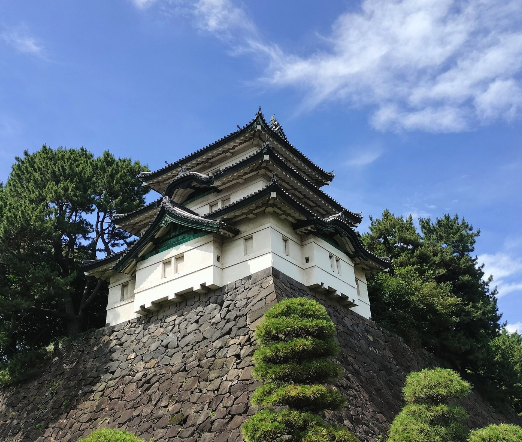
The Tenshukaku is gone. But three smaller yagura (subsidiary keeps) from the original Edo Castle compound survive: Fujimi-yagura (inside the East Garden, built 1659), Fushimi-yagura (visible from the Nijubashi plaza, reportedly relocated from Fushimi Castle in Kyoto), and Tatsumi-yagura (inside the East Garden). The Fujimi-yagura is included in the Edo Castle Garden Walking Tour — the standard 2-hour tours do not reach it.
The grounds contain around 300,000 trees from every prefecture in Japan
The Imperial Palace grounds — including areas not open to the public — contain approximately 300,000 trees. Many were contributed by individual prefectures during restoration projects, with the result that the grounds form an unofficial arboretum of Japanese native species. The Fukiage Garden (the Emperor's private area) is specifically managed as a near-natural forest — a significant ecological resource in the middle of a city of 14 million people.
The current palace building is less than 60 years old
The Kyuden — the main palace building where the Emperor works and receives guests — was completed in 1968. The building that preceded it, the Meiji Palace (completed 1888), was destroyed in Allied air raids in May 1945. The current Kyuden was designed in a modernist Japanese style by architect Shōzō Uchii, using traditional roofline forms and materials alongside reinforced concrete. The East Gardens — the former castle inner compound — were opened to the public the same year the current Kyuden was completed.
Emperor Hirohito's surrender broadcast was recorded inside the palace grounds
On August 14, 1945, Emperor Hirohito recorded a speech announcing Japan's acceptance of the Allied Potsdam Declaration — in effect, Japan's surrender — in an underground vault beneath the Imperial Household Agency building on the palace grounds. The recording was smuggled out in a laundry basket to prevent military officers from destroying it. The broadcast was transmitted the following day (August 15) — the first time most Japanese citizens had ever heard the Emperor's voice.
The grounds are roughly the size of Monaco
The total Imperial Palace grounds cover approximately 3.41 square kilometres. The Principality of Monaco covers 2.02 square kilometres. The palace grounds are not a park surrounded by the city — they are a substantial territory at the geographical heart of one of the world's largest urban areas, occupying land that would be among the most expensive per square metre on earth if it were ever sold or developed.
The moat system was designed to make the castle almost impossible to attack
Edo Castle was surrounded by 12 moats arranged in a spiral pattern — not a simple rectangle of water but a complex defensive system requiring any attacker to breach multiple moats in sequence, each protecting a different zone of the castle. The stone walls were not vertical but angled (nozurazumi or kirizumazumi technique) to deflect projectiles and make scaling more difficult. The result was a fortress that was never actually conquered by military force — the Tokugawa shogunate ended through political collapse, not military defeat.
The Fushimi-yagura tower may have witnessed Japan's decisive battle
The Fushimi-yagura keep — visible from the Nijubashi plaza in the outer palace grounds — is reportedly a structure relocated from Fushimi Castle in Kyoto, where the Battle of Fushimi took place in 1600. That battle was a precursor to the decisive Battle of Sekigahara, which determined the successor to Toyotomi Hideyoshi and ultimately led to Tokugawa Ieyasu's appointment as Shogun in 1603. If the relocation story is accurate, the tower is a witness to the events that shaped modern Japan.
The Hyakunin-bansho guardhouse garrison was always from the same four clans
The 100-man garrison that staffed the Hyakunin-bansho (Hundred-Man Guardhouse) in rotating shifts of 20 was drawn from four specific clans: the Iga-gumi (Iga province), the Kōga-gumi (Kōga province), the Negoro-gumi (Negoro), and the Ōkubo-gumi (from the Ōkubo family). All four groups had supported Tokugawa Ieyasu at Sekigahara. The posting was maintained across generations — the great-grandchildren of Sekigahara veterans were still staffing this guardhouse 150 years after the battle. See our East Garden zone guide for more on the guardhouses.
The Tokagakudo Concert Hall walls are made from broken pottery
The 1966 Tokagakudo Concert Hall, built for Empress Kojun's 60th birthday, has outer walls covered entirely in mosaic made from fragments of pottery and ceramic pieces — old bowls, plates, tiles, and vessels broken and reassembled into a new surface. The work was executed by artist Kokei Kobayashi. The result is a building that is simultaneously modern in structure and deeply embedded in Japanese ceramic tradition — each piece of pottery comes from somewhere specific, though the accumulated origins are now unreadable from the outside.
All 15 of these facts are more vivid in person. On a guided Imperial Palace tour, a good guide will tell you several of them as you stand at the relevant structure — the guardhouse, the empty stone base, the moat. That combination of physical presence and historical context is what makes the East Garden one of the most rewarding sites in Tokyo for visitors who come prepared.