⭐ Best Seller
Small Group Walking Tour · Tokyo
✓ Free cancellation up to 24 hours before
The Imperial Palace East Garden is freely accessible to any visitor who arrives on an open day — but most people walk through it the way they walk through any public park, with only the information panels to guide them. This is the gap this tour fills.
The Shogun Historical Walking Tour places every structure in its historical sequence: the gate system that slowed invaders, the guardhouses that encoded the Tokugawa social hierarchy into physical architecture, the stone base where Japan's tallest building once stood, and the garden that replaced the Shogun's private quarters. The guide's role is to make the invisible visible — to show you what you're actually looking at rather than simply describing what's there.
The maximum group size of 15 is not an accident. It means questions get real answers. It means the guide can stop, turn, point, and take time with a detail without losing half the group. It's the reason this tour carries a Viator Badge of Excellence and 4.9 stars from nearly 3,000 reviews — not because the garden is more accessible in a group of 15, but because the knowledge transfer is.
The tour runs approximately 2 hours and covers the main loop of the East Garden on foot — approximately 2.2 km. The route includes paved paths and some gravel surfaces; strollers and wheelchairs can navigate most of the route.
Meet your guide near the Starbucks Coffee at Wadakura Fountain Park. Brief introduction to the day's route and historical context — positioning the Imperial Palace within Edo's original layout and explaining what "Honmaru" (main compound) means and why you're entering it.
Walk to the main East Garden entrance. The guide explains the masugata (square enclosure) gate design — a military innovation requiring any attacking force to make a sharp turn in a confined space, exposing them to fire from above. The gate's timber and plasterwork structure is one of the best-preserved examples of Edo fortification architecture remaining in Tokyo.
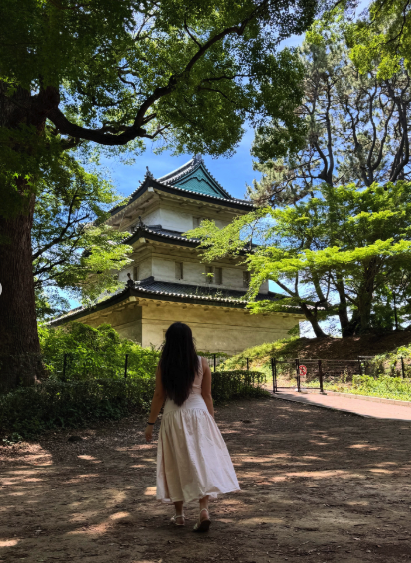
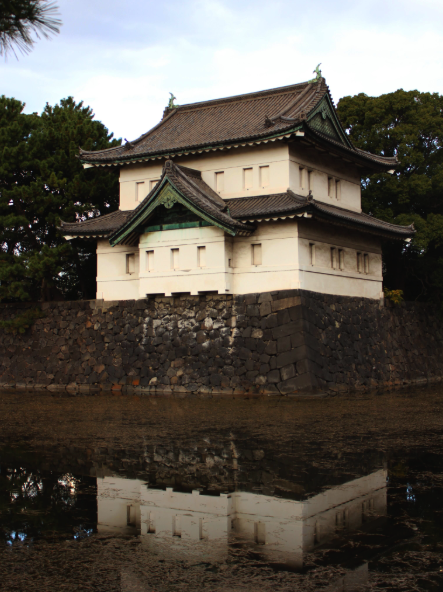
The three surviving Edo guardhouses — Doshin-bansho (low-ranking samurai), Hyakunin-bansho (100-man garrison), and Ōban-sho (senior retainers) — form a graduated sequence from the outer gate to the Shogun's inner compound. The guide explains the four rotational clans who staffed Hyakunin-bansho and why this was an honour posting rather than routine duty.
The most powerful stop on the route. Climb the stone platform where Japan's tallest building once stood — completed 1638, burned 1657, never rebuilt. The guide explains the Meireki Fire, the political decision not to rebuild, and what the empty platform communicates about Tokugawa power in its later period.
The former second fortified enclosure is now a traditional Japanese strolling garden with a central pond, stone lanterns, and the Suwano-chaya tea arbour. The guide explains the transition from military zone to garden — a redesign completed in 1965 — and points out the surviving irises and autumn maples that have made this space a seasonal attraction.
The mosaic-covered 1966 concert hall — built for Empress Kojun's 60th birthday — is visible from the garden. The guide positions it as the architectural bridge between Edo Castle's feudal legacy and the post-war imperial era: a modern building that uses traditional Japanese roofline forms and handmade ceramic mosaic to connect past and present.
The tour concludes near the Ōte-mon Gate exit. The guide remains for questions. From here, the Nijubashi Bridge viewpoint is a 15-minute walk; Tokyo Station is 15 minutes on foot.
Meeting point: Wadakura Fountain Park, 3-1 Kōkyogaien, Chiyoda City, Tokyo — near the Starbucks Coffee. Your guide will hold a company sign at the agreed time.
How to get there: Otemachi Station (Chiyoda/Mita/Tozai/Hanzomon Lines), Exit D2 — 10 minutes' walk. Tokyo Station (Marunouchi Central Exit) — 15 minutes' walk. Nijubashi-mae Station (Chiyoda Line), Exit 6 — 10 minutes' walk.
Arrive: 5 minutes early. The tour starts promptly. If you are late, contact the operator using the number in your booking confirmation.
Group size: Maximum 15 guests per session. If the session you want is full, book the next available time or contact the operator about private tour availability.
What to bring: Comfortable walking shoes. Sun protection April–September. The garden itself is free — no admission ticket required.
Our guide positioned the Tenshukaku ruins in a way that made the absence of the keep more powerful than its presence would have been — you could almost see it from the stone base. A small group of eight, which meant questions were answered properly rather than shouted over people's heads. I came knowing almost nothing about the Tokugawa period and left having genuinely understood it.
We visited with my mother-in-law, who has limited mobility. Our guide was patient and rerouted us to avoid the longest gravel sections. My favourite moment was when the guide explained why the shogunate chose not to rebuild the Tenshukaku keep after the 1657 fire — a deliberate political decision, not just lack of resources. That kind of detail is not on any information panel in the garden.
Our guide spent 45 minutes at the Ōte-mon gate explaining what the masugata enclosure was designed to do — my 11-year-old was completely engaged. The contrast between the outer moat walk and the structured inner garden worked well as a sequence. We would not have connected these elements on our own.
Read all 2,922 reviews on the booking platform. For more experiences from across all tours, visit our reviews page.
Wadakura Fountain Park (3-1 Kōkyogaien, Chiyoda City) — near the Starbucks Coffee, 10 minutes from Otemachi Station (Exit D2) or 15 minutes from Tokyo Station's Marunouchi Central Exit. Your guide will hold a company sign.
Approximately 2 hours, covering around 2.2 km on foot through the East Garden. The route is mostly flat with paved and gravel surfaces. Strollers and wheelchairs can navigate most of the route.
Yes — the tour is stroller-accessible and family-friendly. Children with an interest in history typically engage well. The maximum group size of 15 ensures the guide can adapt delivery to the audience.
Free cancellation up to 24 hours before the tour start time. Cancellations with less than 24 hours' notice are not refunded.
The East Garden is free for all visitors — no admission fee to include. The tour price covers your expert guide and small-group experience only.
English. For other languages, see the private tour options on our main tours page — several operators offer Japanese, Spanish, French, and German guides.
4.9★ · 2,922 reviews · From $22 · Free cancellation up to 24 hours.
Book This Tour →