♿ Top Rated · Accessible
Small Group Walking Tour · Imperial Palace East Garden
✓ Free cancellation up to 24 hours before
This 2.5-hour tour covers more ground in the Imperial Palace East Garden than any other dedicated walking tour. While the Shogun Historical Walking Tour runs 2 hours and prioritises historical depth, this tour adds 30 minutes to include the Fujimi-yagura surviving keep — one of only three original Edo Castle towers still standing — and allows more unhurried time in the Ninomaru Garden.
The tour's other defining feature is accessibility. It has been designed from the ground up to be navigable by wheelchair users and stroller-equipped families — using the accessible paths throughout the garden and offering an alternative viewpoint for the Tenshukaku stone base climb for those who prefer to stay at ground level. No other dedicated Imperial Palace tour makes this provision as explicitly.
The title — "The Emperor and the Shogun" — reflects the tour's dual narrative: the Edo Castle history of the Tokugawa shogunate that shaped the grounds, and the Meiji-era imperial story that transformed them. The guide moves between these two threads throughout, showing how the same physical space was used, understood, and reinterpreted across 400 years.
The East Garden entry is free. Tour fees cover the guide's expertise and the small-group experience. Free cancellation is available up to 24 hours before the tour.
Meet at the fountain park near the Starbucks Coffee. The guide gives a brief overview of what Edo Castle was, where it stood in relation to the Tokugawa shogunate's power structure, and what survives today.
The main entrance. The guide explains the masugata defensive courtyard design and the gate's role as the formal point of entry for daimyo lords visiting the Shogun. The timber structure and plasterwork are among the best-preserved examples of Edo fortification architecture in Tokyo.
Walk through all three guardhouses in sequence. The guide explains the graduated rank system: Doshin-bansho (low-ranking constables), Hyakunin-bansho (100-man garrison), and Ōban-sho (senior retainers). At 30 minutes into the tour, there is more time here than on the 2-hour version — the guide can address the four rotational clans and the specific families who staffed these posts.
The stone platform where Japan's tallest building once stood — completed 1638, burned 1657, never rebuilt. Wheelchair and stroller users can view the base from the accessible approach below while the guide explains the Meireki Fire and the political decision not to rebuild. Those who climb have a panoramic view over the whole garden.
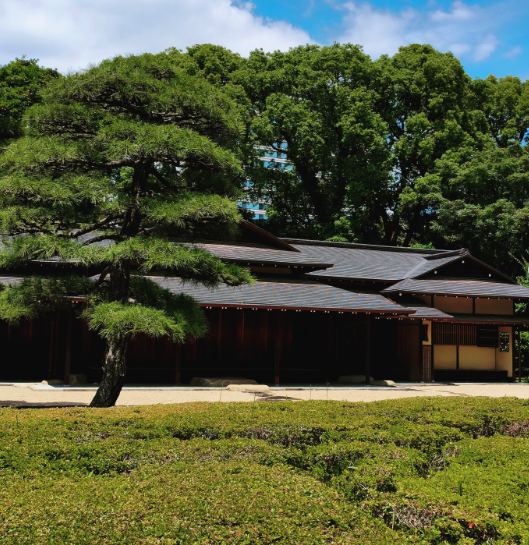
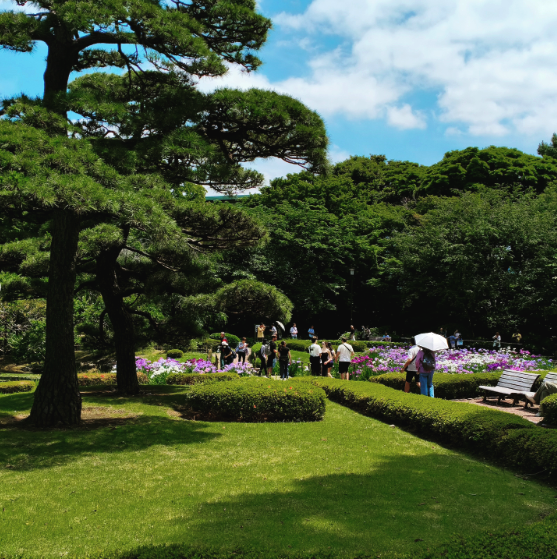
The extra half-hour in this tour shows most clearly here. The guide takes a slower pace through the pond garden, discusses the 1965 redesign, and takes time with the Suwano-chaya tea arbour, the stone lanterns, and the seasonal planting. In autumn, the maple colour is at its peak in this section.
The 1966 mosaic concert hall — built for Empress Kojun's 60th birthday. The guide discusses its place in post-war imperial design and the contrast between its modern construction and the Edo-period stone walls visible from the same vantage point.
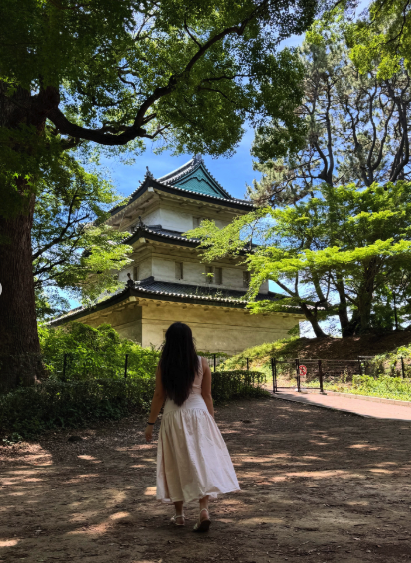
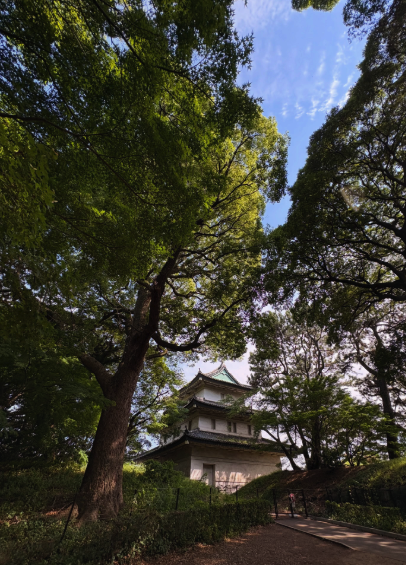
One of three original Edo Castle keeps still standing. The Fujimi-yagura ("Mt. Fuji-view Keep") was built in 1659 — after the Meireki Fire — and survived both the fire and World War II. The guide explains its structural relationship to the lost Tenshukaku and the view it historically offered toward Mount Fuji. This stop is not included in the shorter Shogun tour.
The tour concludes at the main gate. The guide takes questions. The Nijubashi Bridge viewpoint is 15 minutes on foot; Tokyo Station is 15 minutes via the Marunouchi Central Exit.
Meeting point: Wadakura Fountain Park, 3-1 Kōkyogaien, Chiyoda City, Tokyo — near the Starbucks Coffee. Your guide will hold a company sign at the agreed time.
How to get there: Otemachi Station (Chiyoda/Mita/Tozai/Hanzomon Lines), Exit D2 — 10 minutes' walk. Tokyo Station, Marunouchi Central Exit — 15 minutes' walk. Nijubashi-mae Station (Chiyoda Line), Exit 6 — 10 minutes' walk.
Accessibility: The route has been designed to be navigable by wheelchair users and stroller-equipped families throughout. The Tenshukaku stone base climb is the only section that may require an alternative route — accessible viewpoint available at ground level.
Arrive: 5 minutes early. The tour starts promptly.
The extra 30 minutes in the Ninomaru Garden made the difference. Our guide took time with the stone lanterns and the tea arbour and explained the Edo philosophy of garden design — which I'd never encountered before. The Fujimi-yagura stop at the end was also a genuine addition: it made the Tenshukaku ruins we'd seen earlier feel more concrete, because now we had a surviving example of what the keep would have looked like.
The tour itself was excellent — our guide covered the Meireki Fire and its political consequences in a way I've not found in any guidebook. My only mild frustration was that the group was larger than I expected for the price point, which made it difficult to hear in a few exposed areas. Worth booking regardless — the historical context transforms what could be a pleasant park walk into something much richer.
We chose this tour specifically because it was listed as stroller-accessible and wheelchair friendly, visiting with my mother-in-law. Our guide was patient and proactively mentioned the accessible alternative at the stone base before we got there. The Fujimi-yagura was the moment that made the trip — we hadn't expected to see a fully intact surviving keep.
Read all 671 reviews on the booking platform. More experiences from all tours: reviews page →
Approximately 2.5 hours — 30 minutes longer than the Shogun Historical Walking Tour. The extra time allows for more coverage in the Ninomaru Garden and the exclusive Fujimi-yagura Keep stop.
Yes — this tour has been designed to be wheelchair and stroller accessible throughout. The Tenshukaku stone base climb is optional; an accessible ground-level viewpoint is available. This is the most accessibility-focused dedicated Imperial Palace tour available.
This tour runs 30 minutes longer and includes the Fujimi-yagura Keep, which the Shogun tour does not cover. It is also the most comprehensively accessible tour. Both are 4.9★ rated — the Shogun tour has a higher review count (2,922 vs 671) and starts from $22 vs $35 for this tour. See also: Shogun Historical Walking Tour →
Wadakura Fountain Park, 3-1 Kōkyogaien, Chiyoda City, Tokyo — near the Starbucks Coffee. 10 minutes from Otemachi Station (Exit D2), 15 minutes from Tokyo Station (Marunouchi Central Exit).
Yes — Fujimi-yagura is inside the East Garden grounds. It is one of three original Edo Castle keeps still standing and dates from 1659. It is not included in the shorter 2-hour tours.
Free cancellation up to 24 hours before the tour start time.
4.9★ · 671 reviews · 2.5 hours · Wheelchair accessible · From $35/person.
Book This Tour →